The following is based on a young Hudsonian’s entries in the Eleanor’s Log
on his first sailing adventure. One of the big goals of this restoration is to get Eleanor
back into the water so that she can provide young and old their first sailing experiences.
Sailing is more than just feeling the wind in your hair.
It is communication, understanding teamwork, building confidence, experiencing
something new and developing character. These are the deeper and more
lasting aspects of sailing.
Truly.

Saturday: I am not sure how I came to be on the crew for the trip to New York City for the Operation Sail Parade. Except maybe because my parents thought it would be a good experience for me, a fourteen year old boy, and they knew the Captain. I was promised an adventure. I had never been out sailing. I signed on to be crew with the promise from the Captain to my parents that he would look after me.
One week later, on June 28 at 1:20, just after four hours on the Eleanor, the tiller was in my hand.
“Steered Eleanor. Moved the tiller to the left to go right,
and to the right to go left. Kept her on course as the Captain instructed.”
“Good wind from the north. Sailed Eleanor past Hogs Back.”
As I passed the tiller to the next person, I felt pretty accomplished and satisfied. I felt good about being a member, a real member of the crew as we were called. Everybody took turns on the tiller and after that everybody had to write in the log book about their turn. Everybody took turns doing everything: cooking, sailing, navigating, main sheet, lookout, and resting. During rest time, I went up on the starboard side. I learned that is the right side facing forward and sat on the cabin deck and played the harmonica to entertain the crew. The captain liked that and he said it kept the wind coming.
“Took a place for sleeping on Eleanor.”
I took the cockpit floor. I had a mat and a sleeping bag. The other crew members had places – stern deck, cabin deck, bow, and the Captain slept down below on a bunk. It really wasn’t down below. You just had to get down low to go into the cabin.
“Slept very well under the stars with the gentle rocking
of Eleanor. Up at 5:40 a.m. with change of tide.”
On board Eleanor I experienced everything from being becalmed to sailing in gale winds. On the day of the gale winds, I learned how to work as a team, and I mean TEAM with capital letters. The Captain had to give some orders which I learned had to be followed immediately if we wanted to survive. The wind came in gale force. I didn’t know what a gale force wind was, but it didn’t matter to me. This was terrifying. It was my turn on the main sheet which meant I was the person who would keep us from capsizing, but also keep us moving ahead which is very important for lots of reasons. Terror struck my heart. But, I felt and believed I could do this. I had learned the day before that we were all crew and someone would help me if I needed help. I had to slack the main sheet when the order was called, ‘slack the main sheet’, and ‘hold the main sheet’ when I had to instantly stop slacking the main sheet. Then I had to haul in on the main sheet when the order was called to haul in on the main sheet. To haul in on the main sheet I had to stand up and face the stern and haul in with all my might. Sometimes another crew member would have to help me because the wind was terrific and the sail was over 600 square feet. The waves were called rollers, and they were huge and we had to work our way through the troughs. The boat tipped or heeled over, the water came over the deck and the rail was under at times. This was an adventure . . a terrifying adventure. Once, the main sheet ran through my hands and burned them pretty badly. I learned not to let that happen. I learned about communicating on a boat and maybe even not only on a boat, maybe anytime. When an order is given, like ‘slack the main sheet’, the person giving the order may not have time to look around and see if the order has been carried out. So, a person responds, ‘slacking the main sheet’.. Or ‘let go the anchor’. ‘Letting go the anchor’ would be the response. That’s really important – to answer like that.
“Newburgh Yacht Club is a sailors dream. I am a sailor now.”
The yacht club is hard to get into by sail. Did I mention we do not have a motor? Anyway, after going aground at the narrow entrance to the yacht club (going aground is when everybody scrambles for poles from down below and pushes off) we tied up at the dock and everybody breathed a sigh of relief.
Newburgh has a restaurant, real toilets, and a swimming pool. As one of our men crew member called it . . . a stop with three s’s: shit, shower and shave. On the Eleanor we did have fresh water for ‘washing up’ with and for brushing our teeth, and we did have one of those boat toilets, but it wasn’t like the real thing.
“Captain treated me to a nice steak dinner. Great time in the pool.”

Photo by Russ Cusick, Little Stoney Point Citizens Association
Monday:
“Settling in to my adventure.“
“Yours truly at the helm. Took the tiller while going around Little Stoney Point.
Sailed past enthusiastic fan high up on the mountain side.”
The Coast Guard charged passed us with their motors turned up to full speed causing white caps on the water. We were sailing with the wind and our spinnaker was up so as their wake hit us everything rocked and rolled high in the air. One of our crew strongly reprimanded the speeders.
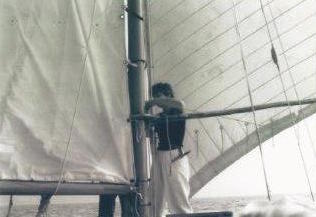
“Took us neatly around Constitution Island through Worlds End. River changes direction here. Changed tacks to get the wind and head on south past West Point.”
“Slept south of Tarrytown Bridge in the river. Threw lead line to figure how deep we were.
Eleanor rocked a little bit. Stars bright and clear. Another great day of sailing.”
Tuesday:
Took tiller at 9:30 a.m. with a southerly wind. Vanquished three boats
and gave the tiller over at the George Washington Bridge at 10:15 a.m.
New York and the tall ships in the distance.”
This is the third of the memories about sailing on the Eleanor from R.S.B. of Rutland, Vermont.

I was crew for the Eleanor on an overnight sail from Catskill to Kingston, NY in the summer of one of my college years. As we loaded the boat Pop fell on the gangplank to the dock that floated in Catskill Creek. He must have been in his 80’s by that time. I went to his side and helped him up. Some of the crew asked if we should abort the sail. Pop insisted that we carry on, not wanting to insult the Eleanor’s dignity. It was an awful sail! There was no wind and the temperature hovered above 95 degrees. We drifted south on the tide of the Hudson for a day. Then, we drifted north on the tide for a day back to Catskill Creek. As we drifted Pop kept us busy constantly changing the sails in an attempt to find any wind. Up with the drifter reacher! Strike that and put up the spinnaker! Again and again we adjusted the sails and rigging. We spent hours paddling in hopes of beating the change in the tide. We found out later that Pop had broken his ribs when he fell. Never give up on a sail! Never let the Eleanor down.
I learned to love the Eleanor.

Louise Bliss spends her days and nights fulfilling the responsibilities that you normally expect from the leader of a non-profit organization: grantwriting, public speaking, administrative duties…but wait – is that her scraping paint off the hull of an old boat? And is that Bliss wearing a facemask and holding a piece of lumber to steady it during a precision cutting? She knows quite a lot about copper rivets, how to distinguish red from white oak and what green wood is used for, too.
The president of the Hudson River Historic Boat Restoration & Sailing Society, Inc. modestly describes herself as “a gopher. If we need lumber, rivets, epoxy, tools, I’ll study it, research pricing, go out and network with people and learn about it. I’m a lifetime learner,” Bliss says simply. Her labors, and those of many volunteers associated with the Hudson-based non-profit, are focused on one goal: restoration of the 1903 Clinton Crane sloop Eleanor.
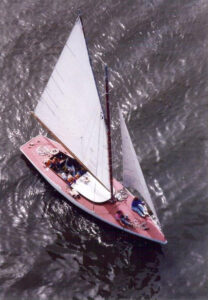
The 12-meter racing sloop is entered in the US National Register of Historic Places (1982) and the New York State Register of Historic Places (1983), and is the last known example of a “raceabout”: a class of boats designed for speed. As such, Eleanor offers sailing enthusiasts, master craftsmen, history buffs and boat designers a rare opportunity to observe an important chapter in the evolution of sailing and sailboat design. Once restoration of the nine-passenger sloop designed by Clinton Crane in 1903 is complete, it will become what Bliss calls “an intimate classroom.”

“The Eleanor is small enough that passengers are part of a team. On this boat, you’re involved in sailing. You don’t just sit and watch someone else haul the lines; you’re part of the crew. We may allow a few more people on board if the weather is good, but nine would be the limit in stormy weather,” says Bliss.
The restoration began in earnest when ownership of the Eleanor was transferred to the Hudson River Historic Boat Restoration & Sailing Society in 2011. One of the many challenges inherent in restoring Eleanor has been that when Clinton Crane died in 1957, all plans for the boat that he created were burned. Restoration plans had to be created from existing boats such as Crane’s Idem Class racing sloop the Water Witch, on display at the Adirondack Museum.
Shortly after bringing Eleanor to Hudson, the organization invited Jim Kricker of Rondout Woodworking in Saugerties to take a look at the boat. “His help has been extremely important for us,” says Bliss. Kricker wrote a complete plan for the ambitious boat restoration, from setting up shop to outlining materials and projecting costs and time estimates. “We’ve been following Jim’s plan and refer to his suggestions often. Just the other day, we needed some copper nails, and I called him, because copper is so expensive.”
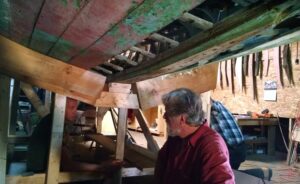
In March of this year, volunteers finally turned their attention from the painstaking process of taking Eleanor apart to begin the reconstruction process. A new keelson was installed to support the sloop’s new floor, new ribs and reconstruction of the transom. Mast hoops were cut this month, and new white oak flooring is being laid.
Bliss, who has lived by the Hudson River and worked around boats since she was 12 years old, acknowledges that wooden boat restoration requires an abundance of patience. “We volunteers work together on Thursday evenings, and it’s a cohesive, fun group of people. We’ve established an informal boat school ourselves here in Hudson,” she says, adding, “We’re not licensed, but we’ve learned a great deal about how boats are made.”
This learning curve took a slight turn when workers uncovered a little secret: Eleanor’s floors were asymmetrical. “Eleanor has a rustic, very strong assembly, and she was in very good condition for her age. Often boats this old are sitting in a field somewhere with grass growing up through their hull,” says Bliss. “She’s not symmetrical, but she was built the way she would be strongest. And at about 6,000 pounds, she’s a very lightweight boat, built for racing.”
Part of Bliss’s job is ensuring that US government standards for historic preservation are followed. “The Eleanor is an important part of the history of the Hudson River and the Catskills. Her home port was Catskill from 1927 to 1998, and a lot of people in the area sailed on her and learned to sail on her. We wanted to see her on the water again. We’re doing all of this work for public enjoyment, and because of our love for sailing and education about boating and the Hudson River,” she says.
 “The Hudson is a great river for boating because when you’re out on the water, you’re close enough to both shores to see many interesting and beautiful things. Sailing is a great vehicle for learning about yourself, who you are and how to work with other people. Eleanor belongs to the public and to the Hudson River Historic Boat Restoration & Sailing Society, not to just a few people. She was deeded over to our organization, and we take the responsibility very seriously.”
On May 31, an Edwardian Great Lawn and Porch Party – and a silent auction – will be held at the Rokeby Estate to raise funds needed to restore the Eleanor. The afternoon event features a 4 p.m. talk by noted sailor, bowman, tactician and navigator Halsey Herreshoff. The octogenarian is well-known and respected in sailing circles for four successful America’s Cup defenses. “Our speaker also designed boats for speed – bigger ones, classified as yachts – and he was a competitor of Clinton Crane. This is our first major fundraiser,” continues Bliss, “and we hope to raise a significant amount of funding.”
Guests are welcome to stroll the grounds of Rokeby, built in 1815 and one of the Hudson Valley’s premier estates. The Grand Hall, library, parlor and dining room will also be open for viewing. Bruno Café in Hudson will provide Edwardian picnic fare and sparkling beverages, and the Blackiston Twins will perform keyboard duets of what Bliss calls “good-time music of the 1920s and ’30s. It’s listening and dancing music and, in honor of our special occasion, they have even added a tune from 1903 to their repertoire. And of course, people are encouraged to dress up in Edwardian style – even if they just wear a bowler hat.”
*
Edwardian Great Lawn & Porch Party, Sunday, May 31, 3-6 p.m. (rain or shine), $75 (reservations by May 20), Rokeby Estate, 845 River Road, Barrytown; (518) 828-7884, www.hudsonriverhistoricboat.org.