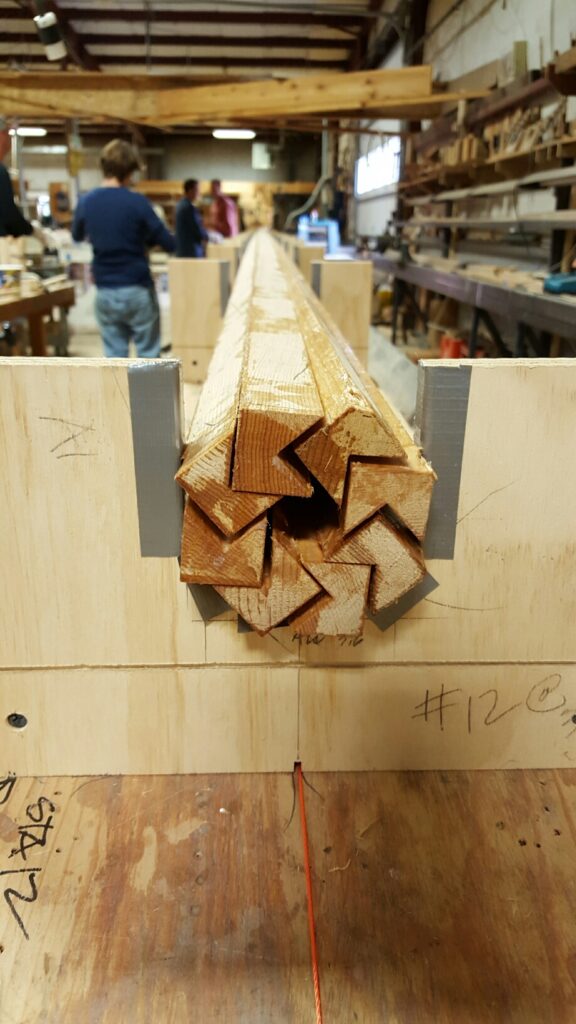
Suzanne Leahy, Spar Builder at the Beetle Boat Company in Wareham, Mass. and her crew have been taking the work of building the mast for the sailboat Eleanor very seriously. The Hudson River Historic Boat Restoration & Sailing Society contracted with the Beetle Boat Company last summer to build the 35’3″ mast, the 25′ boom and the 14′ gaff. The light weight mast is built using staves cut from Sitka Spruce from the north western part of the United States. Suzanne says that the spruce stock is some of the best/clearest she has ever seen. The photo shows the staves in the birds mouth technique of spar building before they are clamped. The mast will be loaded onto a 40′ lathe which will shape the mast into its final round shape.
The goal of $18,000.00, the cost to build the three spars, was achieved through sales of souvenir hand crafted wooden Eleanor ornaments, tee shirts, contributions from members and friends, and fund raisers; the most recent one, The Great Lawn and Grand Porch Party held in May at Rokeby, Barrytown. The next major fund raising effort will be for the sails which are being custom made for the 1903 Clinton Crane sailboat by Nat Wilson, in East Boothbay, Maine. To insure that all parts of the rig are in balance it was necessary for Wilson and Leahy to collaborate on the sail and spar plan.
One important goal of Hudson River Historic Boat’s mission, often overlooked when we are talking about ourselves during this period of intense focus on reconstruction of Eleanor, is to “serve as a resource for the general public who . . . desire to learn how to sail.
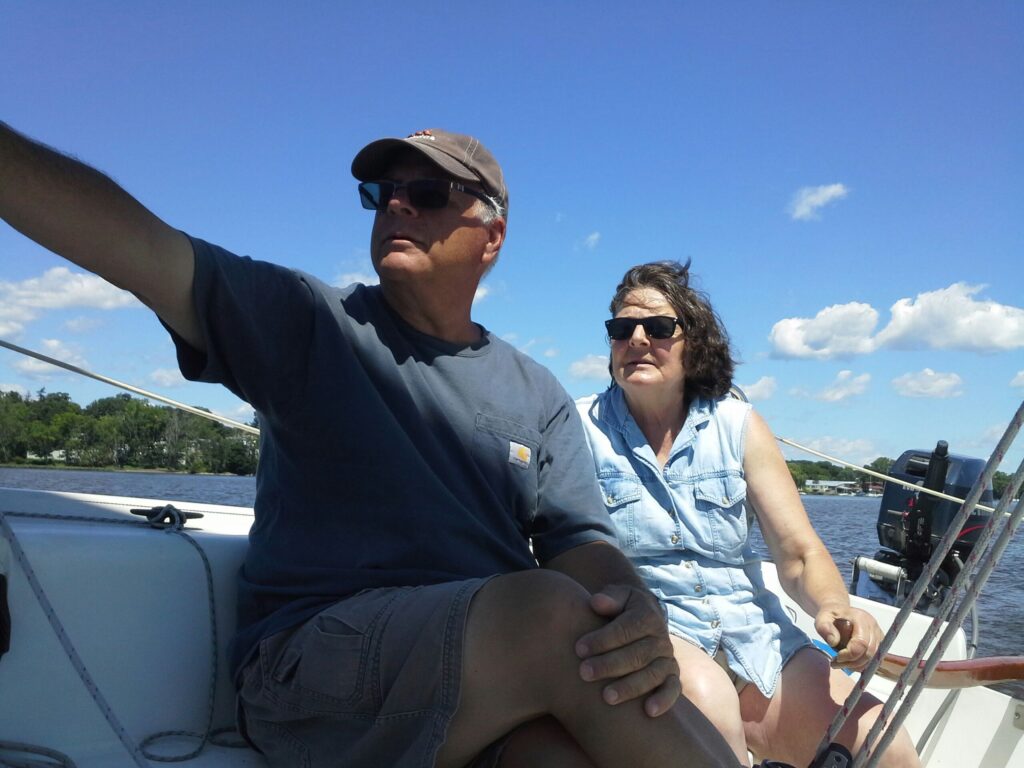
Member Pete Tenerowicz on a teaching sail with Hudson resident Kathy Hamm Parchuck
Today there is an article in the New York Times by Maya Jasanoff who is writing a book on Joseph Conrad.
Before Conrad published his first novel in 1895, he spent 20 years working as
a merchant sailor, mostly on sailing ships, and fully half his writing — including
“Heart of Darkness,” “Lord Jim” and “The Secret Sharer” — deals with sailors,
ships and the sea. These loom so large for him that as I have researched a book
about Conrad’s life and times, I have felt it essential to travel by sea myself.
And she did. Maya “hitched” a ride on the 134 foot brigantine Corwith Cramer, a classroom on the sea for students at Sea Education Association, who for over 40 years has offered field-based environmental education through its accredited study abroad program with Boston University. As a bonus the students learn to sail.

She spent time with “a row of pallid sailors crouched at the leeward rail.” The 12 students who were on board with Maya were learning the
grueling schedule of round-the-clock watch duty, hauling and heaving lines,
setting and striking sails, scrubbing dishes and floors. They were learning the
ropes just as Conrad did, 140 years ago.
It’s hard to think of a less relevant skill in today’s job market than knowing your
jib halyard from your main sheet.
But by the end of her sea journey and the end of her Opinion piece in the paper Maya knows her arduous journey from Cork to Brittany was well worth those uncomfortable, unpleasant moments, and was much more relevant to our present day life than she ever imagined.
I disembarked from the Corwith Cramer knowing things I had not appreciated
otherwise. I learned that to stay on course at the helm you have to watch the
horizon more than the compass. I learned that sails balance a ship, so much
so that oceangoing steamships carried rigs for stability long after they used
them for auxiliary power. I learned how to steady myself by swinging like the
gimbaled tables in the saloon, which seesawed wildly with the ship’s roll while
plates and glasses didn’t budge.
She gained new insight into Conrad, progress and obsolescence, and of the value and art and ethics of sailing. But she says it so well that reading her article in full is a must.
We at HRHB aren’t taking to the the oceans in tall ships with novice seamen and seawomen, but we do have our own education program. Volunteer craftsmen meet every Thursday night where they share skills on shipbuilding, restoration, woodworking and the physics of sail.

Hard at work/play at the reconstruction site last Thursday
We teach interested persons how to sail while developing a relationship with the Hudson River by gaining an appreciation for the river’s history, an awareness of nature’s forces and the river’s environment while instilling a love for sailing. Pete Tenerowicz, member of HRHB took Kathy Hamm Parchuck of Hudson for a lesson this July.
President Louise Bliss writes:
Parchuck, after returning to shore took time to reflect on her sailing lesson
and experience. Just keeping your head, listening to and following directions
are some of the pieces of wisdom that Parchuck took to heart. Terms such as
apparent wind, tack, stays, jib, come about, hold your course, and main sheet
are now part of Parchuck’s vocabulary. Tenerowicz has been sailing since he
was a kid. His experience of over 30 years makes Tenerowicz a knowledgeable
teacher. Tenerowicz says that anyone can learn to sail if you have time and like
being on the water. Money and fame, Tenerowicz says are not part of the criteria
for learning how to sail.
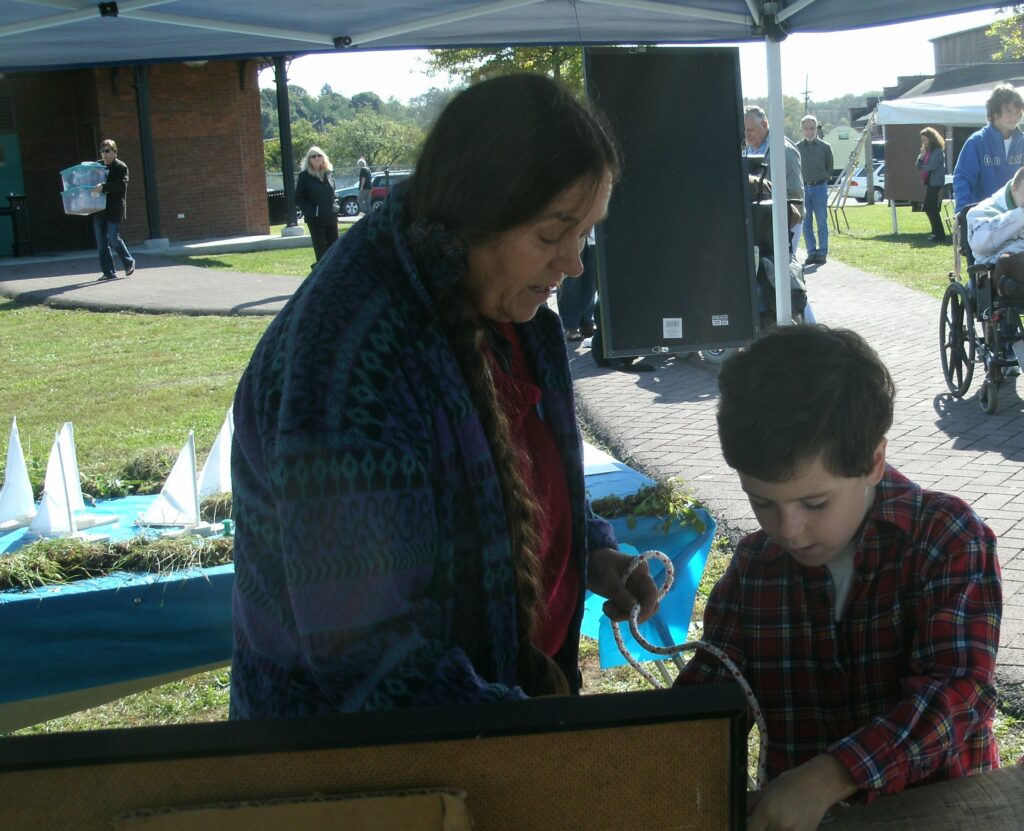
Our Education Tent is a familiar and popular stop at many Hudson outdoor fairs and gatherings. This year we demonstrated steaming and shaping white oak into new mast hoops in our home-made steamer at the Mohawk Hudson Council of Yacht Clubs Boating Festival at Henry Hudson Park. Acquiring the skills to make our own mast hoops and the tools we needed to do it took much experimentation and rethinking and we are still learning and honing our techniques.
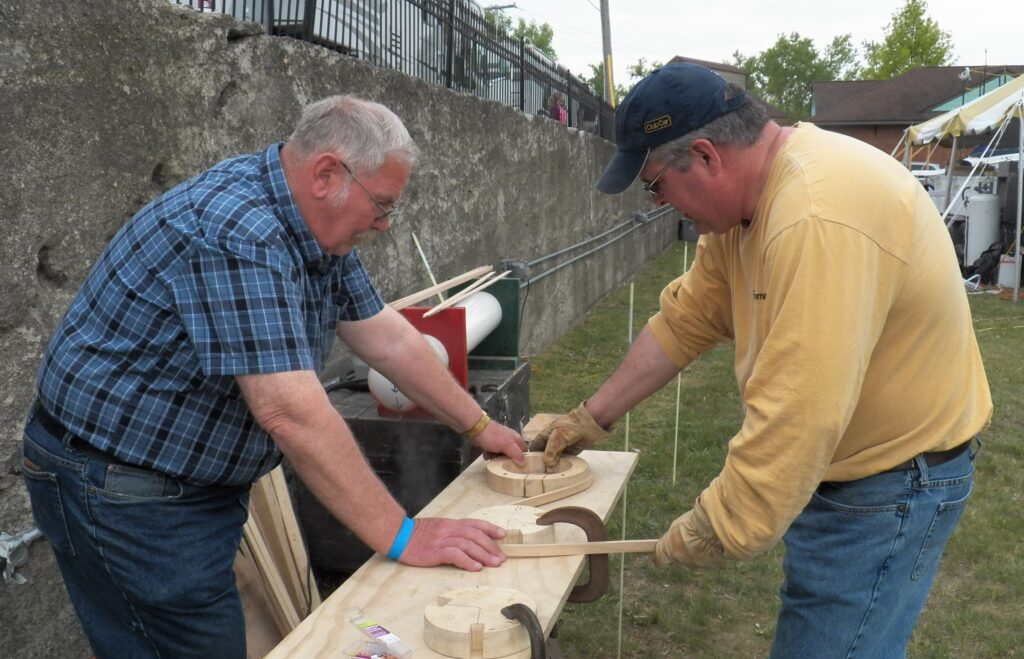
The Education Tent also is a place where young are introduced to the possibility that they too can become sailors and hopefully some of them will walk away with the desire to learn how to sail.

Mark Clarke, a friend and sometime sailor on the Eleanor, wrote about Captain Phil Egan
in this tribute published in the Register Star in August 1998.
Mark was an English teacher at Taconic Hills Central School District
and crewed on one of Eleanor’s OpSail adventures.

Recently, when we were in Washington D.C., my wife and I heard about Phil Egan’s passing. Although Phil was 95 years old and recently not enjoying the best of health, the news came painfully. Obituaries, however informative they may be, always seem inadequate when trying to form a complete picture of a person’s life. The leave so many holes. Like intricate puzzles, they always seem to be missing significant pieces.
I have known Phil for many years; he was a friend. He was the kind of person Charles Kuralt loved to seek out and interview for his television show, “On the Road.”
Phil had what we call in the Adirondacks “character.” Simply, he had a colorful personality, stood by his convictions, and possessed some peculiarity. For Phil, that peculiarity was his unusual passion for sailing.
Phil had a kind of love affair with sailing in which the poet John Masefield fervently writes in his poem entitled “Sea-fever.”
I must down to the sea again, for the call of the running tide
Is a wild call and a clear call that may not be denied;
And all I ask is a windy day with the white clouds flying,
And the flung spray and the blown spume, and the sea-gulls crying.”
At the beginning of this century, Phil’s love for sailing would lure him from the family farm in Columbia County and direct hit to the Maritime College in New York. As part of his naval training, he sailed to the Azores and back on a tall ship. it was quite an adventure as he told it. it was required of him to identify and name every part of the ship. (Several years ago, I was amazed when he recounted the name of every component of a tall ship from South America which was berthed in the port of Albany. He was late in his eighties!) Another part of his training was to climb up one side of the rigging and down the other. Hardly a simple task given the pitch and roll of a tall ship at sea. Grinning, Phillip admitted to me that he acquired a fondness for this activity.
But sailing came with its perils. On a more serious note, he recalled one cadet who fell from aloft and was killed. Because a land burial was not practical, the cadet was sewn in canvas, given a proper Christian service and the buried at sea. It was a reminder, Phil recounted, that the sea had her ways and that she was unforgiving for even the slightest error.
Upon his graduation it was necessary for him to return to the farm and manage the family’s affairs. Years would come and year would pass but he retained his youthful love for the sea.

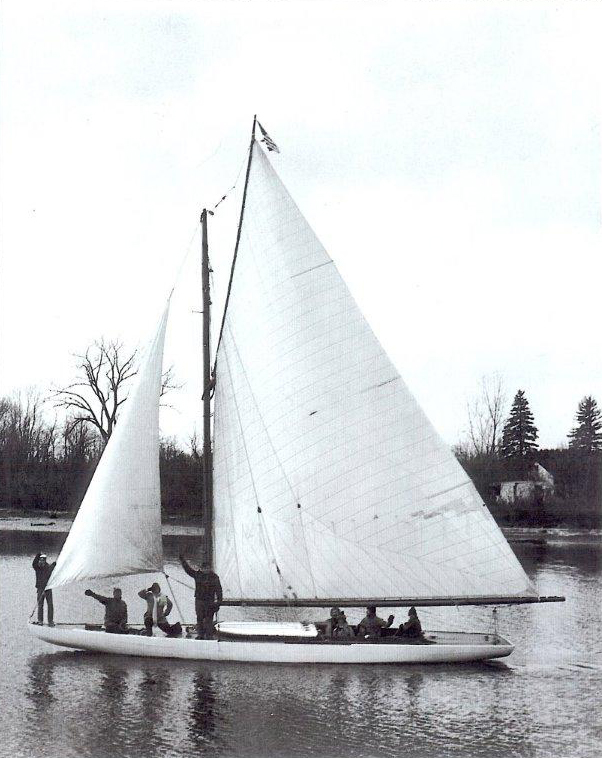
Eventually, the passion became too much for him and he purchased the “Eleanor”, a wonderful old sailing sloop. She had a sleek wooden hull which sailed low in the water. As Phil told it, she had at one time been owned by the Livingston family. She had a lead keel which could be lowered beneath the hull to give it balance should the wind wish to lay her on her side. The mainsail was attached to wooden hoops which were manually hoisted to the top of the mast. An additional large triangular sail, the spinnaker, could be set on a long light pole at the bow of the ship to increase speed when “running before the wind.”
This is how I got to know Phil. I imagine that is how most people got to know him. He might start a conversation with, “Do you like to sail?” and then somewhere in the conversation extend an invitation to go sailing on The Eleanor. Phil’s friendships always seem to share the common denominator of sailing. One thing that was so unique about The Eleanor was that there was no auxiliary power. Translation: everywhere that The Eleanor sailed, she would have to advance under sail. This left little room for error. Very little.
Once when we were sailing up river (destination the Port of Albany) we happened upon a sudden squall. We quickly donned our oil skins (rain gear) and headed for the nearest marina. In order to make a safe an timely berth we would have had to “come about” 180 degrees and sail against the current and into the wind. The skipper let loose a blast from the fog horn, informing the marina of our impending berthing, then brought The Eleanor around and into the wind. Several people scrambled to the dock and yelled “Lower your sailed and come in under power.” He yelled back, “We have no power. We’re sailing her in.” The look on their faces was similar to what I expect classed across the faces of those who witnessed the 1937 Hindenburg Disaster. Undaunted, the skipper brought her in skillfully, against wind and tide, amid torrential down pour.

Sailing was not always a pleasant experience because it required simple living and we were always at the mercy of the elements. I can vividly remember sitting in mid-channel of the Hudson River just beyond the opening of the Catskill Creek: the cruel August sun beating down. Suffering, we waited patiently for a favorable change in the tide or hoped for an agreeable wind to come and fill our sails. When the elements worked against us, the skipper would suggest for someone to lightly scratch the mast with their nails while whistling a soothing tune. This, he explained, had the magic to say the forces of nature and bring favorable winds our way.
But when our sails were full and we cut a fine line in the water, it was truly a sight to behold. The Eleanor would majestically slice through the water; her mast tilted, the boom extended and the sails gorged with wind. Never was their [sic] such grace, neve was their such bliss.
Phil didn’t quite capture the image of the seasoned sailor. You know the kind, hardened men who use rough language. The kind of person you might find down a cobblestone street drinking in a sea-side tavern. A leather faced man with a patch drawn over one eye and a parrot perched on the opposite shoulder. Sitting alone [sic] with a cold pint tightly fisted in his hand, he would occasionally mumble something about having served with Lord Nelson at Trafalgar.
To the contrary, Phil was very different. He had gentle eyes and a wide warm smile. He never drank, swore and had a deep unshakable faith in God. Periodically he would take someone sailing up the Hudson River for a nominal fee, which he would then donate to charity. He had the curious habit of whistling without carrying any discernible tune. It must have been a generational peculiarity for I have found this unique only to my grandparents.

Phil was an anachronism. He held all of the characteristics of a 19th century sailor. That was a time when ships were made of wood and men were made of steel. Today, the ships are made of steel and the the men are made of wood. Phil held the oldest sailing license on the river. Phil was a steel of a man.
Bit the most remarkable aspect of Phil was not his love of sailing. No, it was far greater than that. His greatest attribute is that he never had a bad word about anyone and conversely, I never head anyone say a bad word about anyone and conversely, I never head anyone say a bad word about him. Imagine, living a lifetime and when it comes to a close, no one can find an unkind thing to say about you! That is remarkable.
Having just returned from Washington it has given me time to pause and reflect. Washington, known as the city of monuments, pays tribute to many great Americans: Washington, Jefferson, Lincoln. . . But I don’t suspect that there will be any monuments erected to the Phil Egans of the world too soon, and I’m sure that he wouldn’t want it any other way. Yes, as people, there is something here for us to learn. Phil’s passing reminds us of the wonderment and the preciousness of life. Anyone who knew Phil would agree that life wasn’t meant to be lived; on the contrary, it was meant to be celebrated.
The poet, Edgar Lee Master, wrote a poem entitled “Fiddler Jones.” It is about the reflection of a man on his past life.
I ended up with 40 acres, a broken fiddle,
a broken laugh, a thousand memories,
and not one regret.
Phil Egan reminded me of Fiddler Jones. He will be missed.